Just watch this great documentary, Who Killed the Electric Car, by Chris Paine about the electric car and suspense....how big (oil and car) corporations as well as the US government buried it alive before it stood a chance.
We could have been driving them for the past 15 years, in fact they were on the roads for a few years though most consumers never knew about it because car makers didn't promote them.
They worked just as great as any car, except they cost less to run, they cause less pollution and they don't make us dependent on foreign oil and Middle eastern dictatorships. Seems like a no-brainer, except for the fact that they don't make money for the oil companies and their corporate friends..
To find out more about the rise and fall of the electric car, watch the film!
Saturday, March 27, 2010


Saturday, February 20, 2010
Chris Jordan's photography
From the photographer Chris Jordan:
These photographs of albatross chicks were made in September, 2009, on Midway Atoll, a tiny stretch of sand and coral near the middle of the North Pacific. The nesting babies are fed bellies-full of plastic by their parents, who soar out over the vast polluted ocean collecting what looks to them like food to bring back to their young. On this diet of human trash, every year tens of thousands of albatross chicks die on Midway from starvation, toxicity, and choking.
To document this phenomenon as faithfully as possible, not a single piece of plastic in any of these photographs was moved, placed, manipulated, arranged, or altered in any way. These images depict the actual stomach contents of baby birds in one of the world's most remote marine sanctuaries, more than 2000 miles from the nearest continent.


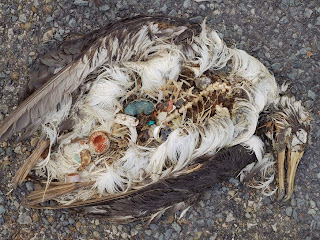
Five tons of garbage end up in the bodies of albatrosses each year, in one of the most remote islands on Earth... something to think about..
Check out more on Chris Jordan's site.
These photographs of albatross chicks were made in September, 2009, on Midway Atoll, a tiny stretch of sand and coral near the middle of the North Pacific. The nesting babies are fed bellies-full of plastic by their parents, who soar out over the vast polluted ocean collecting what looks to them like food to bring back to their young. On this diet of human trash, every year tens of thousands of albatross chicks die on Midway from starvation, toxicity, and choking.
To document this phenomenon as faithfully as possible, not a single piece of plastic in any of these photographs was moved, placed, manipulated, arranged, or altered in any way. These images depict the actual stomach contents of baby birds in one of the world's most remote marine sanctuaries, more than 2000 miles from the nearest continent.
Five tons of garbage end up in the bodies of albatrosses each year, in one of the most remote islands on Earth... something to think about..
Check out more on Chris Jordan's site.
CocaLife: Coca-Cola for social good?
 I've often been amazed, while traveling to the most remote places on Earth, of Coca-Cola's reach.
From small African villages in the middle of the jungle, to isolated communities in the mountains of India, Coca-Cola ads and drinks bring you a sense of familiarity that can be disturbing in the surrounding context.
Coca-Cola has managed distribution like no other company in the world and overcome many of the transportation challenges that aid agencies are still struggling with in countries where the lack of infrastructure is a serious obstacle.
Innovator Simon Berry has been working for the past couple years on the CocaLife campaign to use the efficiency of the corporate giant to benefit the needs of the world's poorest and most isolated. His idea is simple and started with a simple thought 20 years ago, while he was working on the British Aid programme:
What about Coca Cola using their distribution channels (which are amazing in developing countries) to carry 'social products', such as oral rehydration salts? Maybe by dedicating one compartment in every 10 crates as 'the life saving' compartment?
 While the idea never initially took off, new social media has given it a second life and its supporters are growing every day. The campaign created enough pressure on the corporation that Berry was invited to address the heads of Coca-Cola and, while progress takes time, the project is moving slowly but surely.
Become a fan on facebook and help the campaign grow!
Quote of the day
"Small acts, when multiplied by millions of people, can transform the world."
~Howard Zinn
Sunday, December 6, 2009
Too many walls left
 On November 9, Germany celebrated the 20th anniversary of the fall of the Berlin Wall, which reconciled the East and West after 28 years of separation, and marked the beginning of the collapse of communism in Europe.
It became a symbol of freedom and unity - an image so powerful that people can still recall the exact moment they heard the news. I was six and watched the event unfold on our kitchen's television screen. Though I could not understand at the time its importance, the live historical moment has remained ingrained in my memory, much like sadder news of 9/11 will also likely stay forever in the minds of those who lived through it.
While the Berlin Wall's fall is certainly an event worthy of celebration, it should also be an occasion to bring attention to the many walls that have sprung up since, around the world, as obstacles to freedom, equality, and peace.
Five examples, some better-known than others, come to mind:
 1) The wall dividing Israel and the Western Bank is 8 meters high and when completed will be 703 kilometers long. It is claimed by the Israeli government to be protecting its citizens from suicide bombers but has been condemned by the International Court of Justice as contrary to international law. An Amnesty International 2004 report states:
Since the summer of 2002 the Israeli army has been destroying large areas of Palestinian agricultural land, as well as other properties, to make way for a fence/wall which it is building in the West Bank. In addition to the large areas of particularly fertile Palestinian farmland that have been destroyed, other larger areas have been cut off from the rest of the West Bank by the fence/wall. The fence/wall is not being built between Israel and the Occupied Territories but mostly (close to 90%) inside the West Bank, turning Palestinian towns and villages into isolated enclaves, cutting off communities and families from each other, separating farmers from their land and Palestinians from their places of work, education and health care facilities and other essential services.
2) The Mexico-United States barrier consist of fences at the border of both countries and is an attempt by the US to curb illegal immigration and prevent drug trafficking. Several people have died trying to cross the border, and the wall has been causing damages to the environment and the animal habitat.
3) A lesser known "wall of shame" is The Berm of Western Sahara, a 2,700 km sand wall separating the areas controlled by Morocco from those controlled by the Polisario. The two sides have been in dispute ever since the territory gained independence from Spain in 1975.
Morocco (and Mauritania, which later gave up its claim) immediately seized the opportunity to annex the territory - a move that has not been recognized by the international community and been condemned by the International Court of Justice.
Western Sahara is considered a non self-governed territory by the United Nations, though the Sarahwi people are still working tirelessly for Western Sahara's independence through the Polisario Front, and have been diplomatically recognized by 82 countries (not a single European country though). In the meantime they control the mostly un-habited "Free Zone" while most of their people have been forced into exile and live as refugees in camps set up in neighboring Algeria.
4) Even on the small island of Cyprus governments have managed to keep people separated. The island has been divided for over three decades between the Greek Cypriots on one side and the Turkish Cypriots on the other side of the "Green Line". A symbolic wall separating the North from the South side of capital city of Nicosia, gives it the title of "the world's last divided capital".
Since April 2008 though, efforts have been made to reunify the island and the wall dividing the two communities at Ledra Street was opened, allowing people to cross from one side to another for the first time since 1964. It became the sixth crossing between the southern and northern parts of Cyprus and opened up hope that the walls will be teared down for good in the near future.
5) Finally, the DMZ separating the North from South Korea, has divided peoples for more than 50 years and made North Korea one of the most isolated nations on Earth. The Korean DMZ remains the most heavily militarized border in the world, dividing a prosperous and successful country from one the poorest and harshest.
Let us hope that these walls, like the Berlin Wall 20 years ago, will soon fall under the weight of freedom and the power of the people to overcome the obstacles that these walls so concretely express.
In the meantime, like the West Berliners who turned a symbol of darkness around with their tags and graffiti of hope (pieces that eventually became collectors' items), here is a touch of poetry in an otherwise mass of grey - courtesy of Banksy (Palestinian side of the wall):


If you would like to have your own personal message of hope, peace, and love tagged on the wall, and help local Palestinians make a bit of cash, check out this cool initiative.
Thursday, October 29, 2009
This Is It - Michael Jackson's last performance

Fans had been waiting for this film ever since footage of Michael Jackson's last rehearsals made their appearance on TV screens around the world as headlines announced the King of Pop had died.
In the months following his death, rumors have floated around that MJ did not have it in him to go on for the 50-concerts tour that had sold out within hours. This Is It - his last performance, dispels any rumors that would have you that Jackson could barely walk or speak and that at age 50, he had lost his magic. On the contrary - through close to two hours of footage, fans rediscover the Michael they remember from previous tours, and get transported into a show, that no doubt, would have blown their minds away.
Michael Jackson's perfectionism and talent can be felt through every step he takes and every note he makes. After dazzling his own dancers and technicians through one of the routines, he finishes with a casual "that's just to get the feel for it", leaving us in awe, to imagine what an amazing show the real deal would have been.
As an 80s baby, I grew up listening to a Michael Jackson at the height of his career. By that time though, Michael had already been breaking records for 20 years. Like many, I can associate countless of his songs to various memories of my life. Up to the most recent, when a few days after his death, I came across a gathering on Union Square, in New York. Someone had improvised a DJ booth and was playing all of the classics, as all of us, strangers from all walks of life, danced and sang in one last celebration. As David Segal wrote in the New York Times,
"Watching this spectacle, you had to wonder: When will this happen again? When will another pop culture figure mean so much to so many that people are moved to assemble, hug and dance?", concluding that "fame on the level that Mr. Jackson achieved is all but impossible for pop culture heroes today, and quite likely it will never be possible again."
Yet, as the media world rode the Michael Jackson wave for weeks on end, as if the rest of the world had stopped to move, and images of Iranians fighting for democracy in the streets of Tehran faded in our memories, people began to complain about the Jackson overload and asked for a return to serious matters. Others, like Don Gomez, an Iraq war veteran, felt Michael Jackson deserved the attention, one last time. He wrote in his blog:
"One of the strangest things I experienced in Iraq during my two tours there was the multitude of "Michael Jackson" stories I brought home.
I remember watching Baghdad children moonwalk during lulls in our foot patrols to try to get our attention.
I remember children waving to us and simply saying “Mike-kal Jack-son” to express affection and get us to look at them."
Now Michael Jackson makes his final appearance on the world stage. He will be remembered as an unsurpassed entertainer, as a music and dance genius, and as a unique soul- at his best and at his worst. No matter what, he brought people from all corners of the world, all social classes, all colors, and all ages together through the talent he shared with all, despite a high personal cost. This Is It shows us a side of him that few ever knew, a demanding professional yes, but one who always concluded his requests with a smiling "LOVE".
Eternal Moonwalk.
Friday, September 25, 2009
September 25, 2009- Earth Overshoot Day
 Today is Earth Overshoot Day, meaning that at the end of this 267th day of our calendar year, humanity will have used the biosphere's entire capacity for the year 2009.
When we wake up tomorrow, we will be in "ecological deficit" and will start utilizing resources at a rate faster than what the planet can regenerate in a calendar year. To put clearly, we have used in less than 10 months what the Earth normally takes a whole year to produce - in terms of natural resources and in terms of CO2 quota - the CO2 Earth has the capacity to reabsorb by forests or seas.
According to the Global Footprint Network, which measures human impact on the Earth, "we currently maintain this overshoot by liquidating the planet’s natural resources. For example we can cut trees faster than they re-grow, and catch fish at a rate faster than they repopulate. While this can be done for a short while, overshoot ultimately leads to the depletion of resources on which our economy depends."
Overshoot started in 1986. Up until then, humanity consumed resources and produced carbon dioxide at a rate consistent with what the planet could produce and reabsorb. Ten years later, in 1996, humanity was using 15 percent more resources in a year than the planet could supply, with Earth Overshoot Day falling in November. In 2009, with our growing population and energy demands, we are now requiring resources at a rate of 40 percent faster than the planet can produce them.
The "good" news is that in 2008, Earth Overshoot Day fell on September 23rd, so it looks like we have gained two days in a year. I'm not sure why that is, if it's a result of successful measures governments have taken to curb their CO2 emissions or if it's simply that in time of crisis people consume less. The bad news though, is that despite that gain, we are still 11 days behind the 2007 Overshoot Day and that we need way more and faster progress for the Earth to get back at its sustainable rate before it is too late.
Not surprising, the United States is the biggest ecological deficit spender and if all people adopted the American lifestyle, with its emphasis on large homes, mobility and voracious use of energy, the world's population would need 5.4 "Earths" to meet its needs.
Canada (with a lifestyle of 4.2 "Earths"), Britain (3.1), Germany (2.5) are also singled out as huge consumers of resources.
As a New Yorker, I rely for the most part on public transport, as a majority of people do, and I'd like to think my carbon footprint is minimal- in fact New Yorkers have some of the smallest carbon footprint in the nation. However, a simple walk around the block is enough to illustrate the amount of consumption and - as a result- waste this city produces. Garbage bags line up the sidewalk on a daily basis - with the rats that go with it. New York has got to be one of the dirtiest city I have ever seen, and still hasn't figured out how, or found the financial resources to, have a proper waste management system in place. I guess this is another issue, but I think we can all play our part to reduce our consumption, recycle more and waste less.
Subscribe to:
Posts (Atom)